10 Lessons from Women Who Built Success Without Losing Themselves.
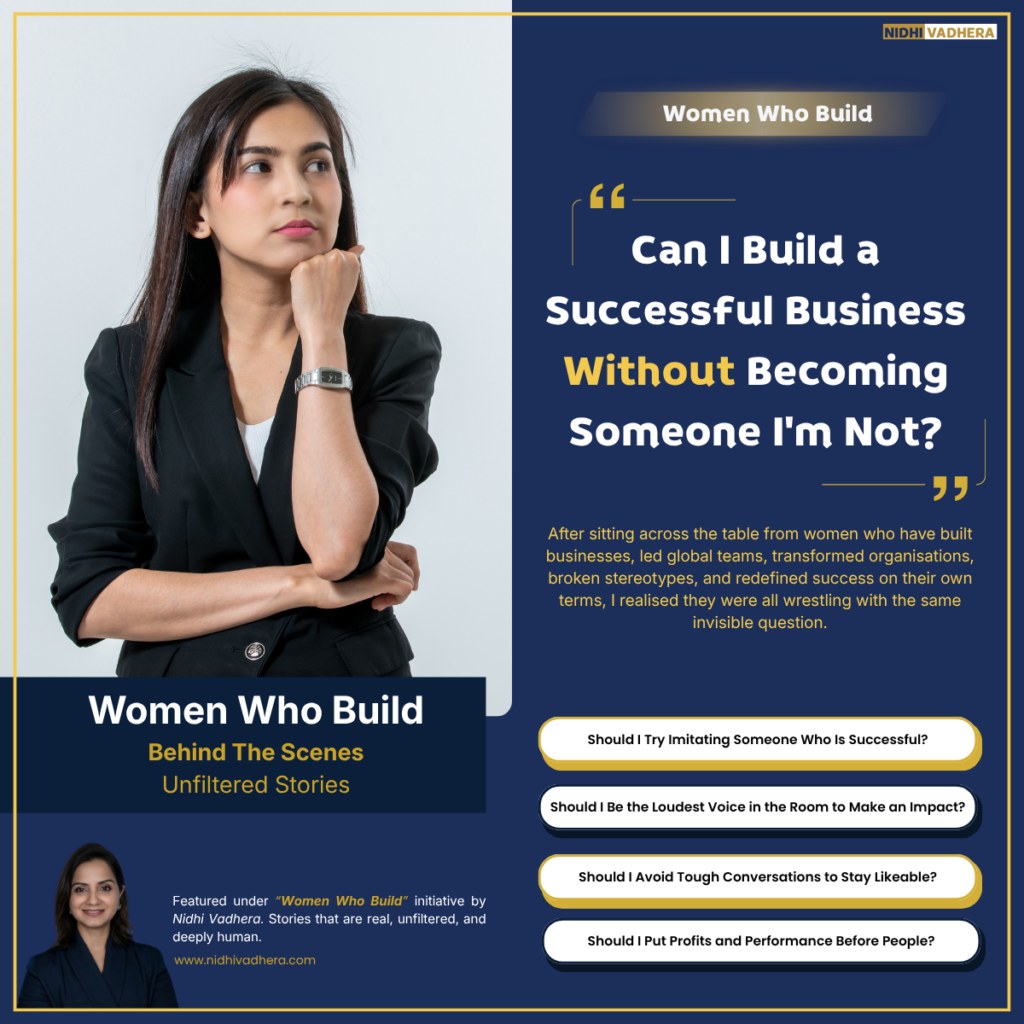
There is one question that has quietly followed me through almost every conversation in the Women Who Build series. Interestingly, it has never appeared on my list of interview questions. No woman has ever looked at me and asked it directly. Yet, after sitting across the table from women who have built businesses, led global teams, transformed organisations, broken stereotypes, and redefined success on their own terms, I realised they were all wrestling with the same invisible question.
Can I become successful without becoming someone I’m not?
When I started Women Who Build, I thought I was documenting journeys of success. I expected conversations around business models, funding, leadership, strategy, scaling, innovation, and growth. And yes, those conversations happened. But somewhere between the discussions about milestones and achievements, another story quietly unfolded.
It was the story of identity.
Whether I was speaking to a first-generation entrepreneur building a business from scratch or a senior corporate leader managing thousands of employees across continents, I noticed the struggle was remarkably similar. Both were navigating environments that subtly suggested there was a certain way successful women should behave. Speak with more authority. Be tougher. Be more visible. Network constantly. Never appear uncertain. Always have the answer. Lead with confidence, but don’t intimidate. Be empathetic, but don’t be emotional. Be ambitious, but don’t appear too ambitious.
The more conversations I had, the more I realised that success often comes wrapped in invisible expectations. The world doesn’t just celebrate successful women; it quietly tries to define what successful women should look like.
What surprised me most was that the women who created the deepest impact rarely fit that mould.
The first observation became evident after just a handful of interviews. The women who built enduring careers and lasting businesses were not trying to imitate anyone else. Their personalities couldn’t have been more different. Some were soft-spoken and deeply reflective. Others walked into a room with infectious energy. Some carefully analysed every decision before acting, while others trusted their instincts. Some loved public speaking, while others preferred letting their work speak for itself. Yet none of them apologised for who they were.
At some point in their journey, they had stopped asking, “What does a successful leader look like?” and had started asking a far more important question: “What kind of leader do I want to become?” That shift changed everything.
The second lesson emerged almost accidentally. Before starting this series, I believed charisma played a significant role in success. After all, we often celebrate the loudest voices in the room. But interview after interview challenged that assumption. Some of the most respected women I met were not exceptionally charismatic. They weren’t trying to command attention every time they spoke. Instead, they had built something far more valuable. Credibility. Customers trusted them because they kept their promises. Colleagues respected them because they were consistent. Teams followed them because their actions matched their words.
Whether they were leading a company or leading a department, they reminded me that trust is built quietly, one commitment at a time.
The third observation challenged another popular belief. Authenticity is often mistaken for being agreeable or avoiding conflict. Nothing could be further from the truth. Many of the women I interviewed had made extraordinarily difficult decisions. Some walked away from lucrative clients because the relationship no longer aligned with their values. Some ended partnerships that looked successful from the outside. Corporate leaders spoke about restructuring teams, making difficult people decisions, and standing by choices that weren’t always popular but were necessary.
Authenticity did not make them softer. It made them clearer.
The fourth lesson changed how I think about confidence itself. Looking at these accomplished women today, it is easy to assume confidence came naturally to them. But almost every conversation revealed the opposite. Behind every successful entrepreneur was a woman who once wondered if she was good enough. Behind every senior executive was someone who had questioned whether she truly belonged in the boardroom. The difference wasn’t the absence of self doubt. The difference was that they refused to let self doubt make their decisions.
Confidence is rarely the starting point of success. More often, it is the reward for repeatedly choosing courage over comfort.
The fifth observation was perhaps the most emotional. Almost every woman had spent years waiting for permission. Permission to start. Permission to lead. Permission to ask for the promotion. Permission to charge what her work was worth. Permission to speak in the meeting. Permission to challenge conventional thinking. Permission to believe she belonged. Then, somewhere along the journey, each of them discovered the same truth. No one was coming to hand them permission.
The day they gave it to themselves became the day everything changed.
The sixth lesson reminded me that growth and authenticity are not opposites. Every woman I interviewed had evolved. Entrepreneurship had made founders financially sharper, more resilient, and better negotiators. Corporate leadership had made executives stronger communicators, better decision makers, and more influential leaders. They had all changed. But none of them had become someone else. Instead, they had become stronger versions of themselves.
That distinction stayed with me because so often we confuse personal growth with losing our identity.
The real growth doesn’t erase who we are. It refines who we are.
The seventh observation centred around empathy, a quality that business conversations often underestimate. Again and again, women spoke about people before they spoke about profits or performance. They remembered the employee who stayed during difficult times. The mentor who believed in them. The customer who trusted them before anyone else did. The manager who gave them an opportunity. The colleague who supported them. What became clear was that exceptional leaders don’t simply build businesses or careers.
They build relationships. And those relationships become the foundation upon which everything else grows.
The eighth lesson challenged our obsession with speed. We celebrate overnight success stories because they make compelling headlines. Yet almost every woman I interviewed spoke about years of invisible work before anyone noticed them. Years of learning. Years of rejection. Years of building credibility. Years of doing ordinary things extraordinarily well.
Whether in entrepreneurship or corporate leadership, meaningful success rarely happened overnight. It was built patiently, one decision, one relationship, and one commitment at a time.
The ninth observation was one I wish every ambitious woman could hear. Comparison quietly steals confidence. Not one woman I interviewed had followed the same timeline. Some found success in their twenties. Others discovered their purpose after raising children. Some built companies after decades in corporate life. Others left entrepreneurship to become transformational leaders within organisations. There was no perfect age. No perfect career path. No universal formula.
Success, isn’t about following someone else’s timeline. It’s about honouring your own.
And finally, the tenth lesson became the thread that connected every conversation. Whether these women were building businesses or building careers, they were ultimately building themselves. Every challenge strengthened their resilience. Every setback deepened their wisdom. Every difficult conversation expanded their confidence. Every failure refined their judgment. The titles they earned were impressive. The organisations they built were inspiring.
But the most remarkable thing they built was the person they became along the way.
As I look back on the Women Who Build series, I realise it has never really been about entrepreneurship alone. Nor has it been only about corporate leadership. It has been about women choosing to lead without losing themselves in the process. It has shown me that success is not about fitting into someone else’s definition of leadership. It is not about becoming louder, tougher, or more like the people we admire from afar. It is about discovering a leadership style that is rooted in our own values, strengthened by continuous learning, and shaped by the courage to stay authentic even when the world encourages conformity.
So, can you become successful without becoming someone you’re not?
After listening to the stories of so many extraordinary women, I believe the answer is YES.
Success will undoubtedly change you. It will demand resilience when you feel like giving up. It will require courage when uncertainty feels overwhelming. It will stretch your thinking, test your patience, and push you beyond every comfort zone you have ever known. But it should never ask you to abandon your integrity, your empathy, your values, or your authentic voice. Whether you are building a startup, leading a global organisation, managing your first team, or aspiring to your next leadership role, remember this: the world doesn’t need another version of someone else. It needs the best version of you. Perhaps that is the greatest lesson Women Who Build has taught me. The women who leave the deepest mark are not those who become someone different in the pursuit of success. They are the ones who become more deeply, more confidently, and more unapologetically themselves.
Blog By: Nidhi Vadhera
Startup Strategist | Investor | Author (Romancing Targets)
Connect with Nidhi On LinkedIn