From doubt and defiance to building a legal-tech venture, Rupal Mathur’s story is one of conviction, courage, and the relentless work of becoming.
Rupal Mathur
Co-Founder: Rhett
Industry: Fintech/ Legal Tech
Startup/Business Stage: Growing
Location: Mumbai, India
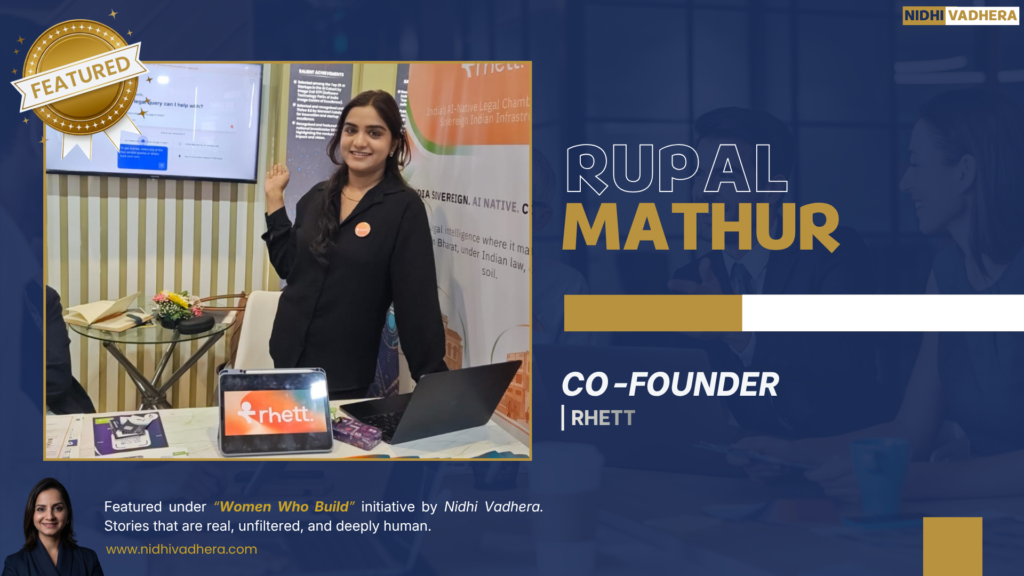
Rupal is a legal-tech innovator, a certified PoSH trainer and consultant, and a startup legal advisor with expertise in labor laws, privacy, intellectual property, GenCorp, and regulatory tech, committed to helping businesses stay compliant and future-ready.
Sometimes, the safer option is actually the bigger risk because it can take one further away from who they really want to be.
At 20, while pursuing BBA LLB at National Law University, Shimla, Rupal Mathur found herself standing at what looked like a clear, predictable path. Placements, a stable job, a life that made perfect sense on paper. But something didn’t sit right. During COVID, that discomfort only grew louder. She began to lose faith in the idea that college would seamlessly lead to a job, and more importantly, she realised she didn’t want a life where she was taking orders. The idea of a conventional office routine felt almost suffocating, and slowly, that discomfort began turning into a decision waiting to be made.
This wasn’t a random impulse. Rupal had grown up watching her father, a businessman in the shipping and hospitality industry, build not just a business but a reputation and identity that commanded respect. That stayed with her. Somewhere along the way, she knew she wanted to build something of her own and not follow the predictable path. Around the same time, a classmate, who is now her co-founder, shared an article about a Punjab government startup competition for budding entrepreneurs. They decided to participate, almost experimentally. And as if destiny was aligning the dots, they won. In that moment, it wasn’t just about the recognition or the prize money. It felt like permission to think differently and to consider a life beyond the obvious path. From one stage to another, Rupal started winning competitions, getting recognised.
But as is often the case, opportunities didn’t bring clarity. They brought questions:
- What if I invest all my time and energy and a few years down the line, nothing shapes up the way I imagined?
- Would that mean losing out on a stable job and the time I could have invested there?
- What happens after I exhaust the prize money?
- Will this even be enough to get the entrepreneurship ball rolling?
The questions didn’t fade, they intensified. Around her, everyone seemed to be moving ahead. Batchmates were securing jobs, building careers, finding direction. But she was navigating a very different kind of pressure. And then came the societal expectations. Conversations around marriage had begun, and the silent timelines imposed on women started closing in.
It took her almost a year to arrive at a decision. Not because Rupal found the answers, but because she realised that waiting for certainty was just another way of staying stuck.
So she chose to begin.
That decision, however, came with its own realities. Rupal’s family was supportive, but equally cautious. There were real concerns: How would she manage expenditure and revenue generation? What kind of stability could she create? Would this ever become a sustainable business?
Since Rupal was financially dependent on her family, their approval mattered before she could take any step forward. And that didn’t come easily.
In the early days, the family didn’t take her seriously, and relatives didn’t hesitate to undermine her efforts or openly question her choices. Faced with that level of judgment, Rupal admits she became rude and rebellious in her responses. “There was little emotional backing, and my mother was deeply influenced by societal opinions, worrying constantly about what people would say,” she adds.
Somewhere within that resistance, Rupal found her anchor. Self-conviction. She decided that if support wasn’t available, she would build with whatever she had.
And so, she did.
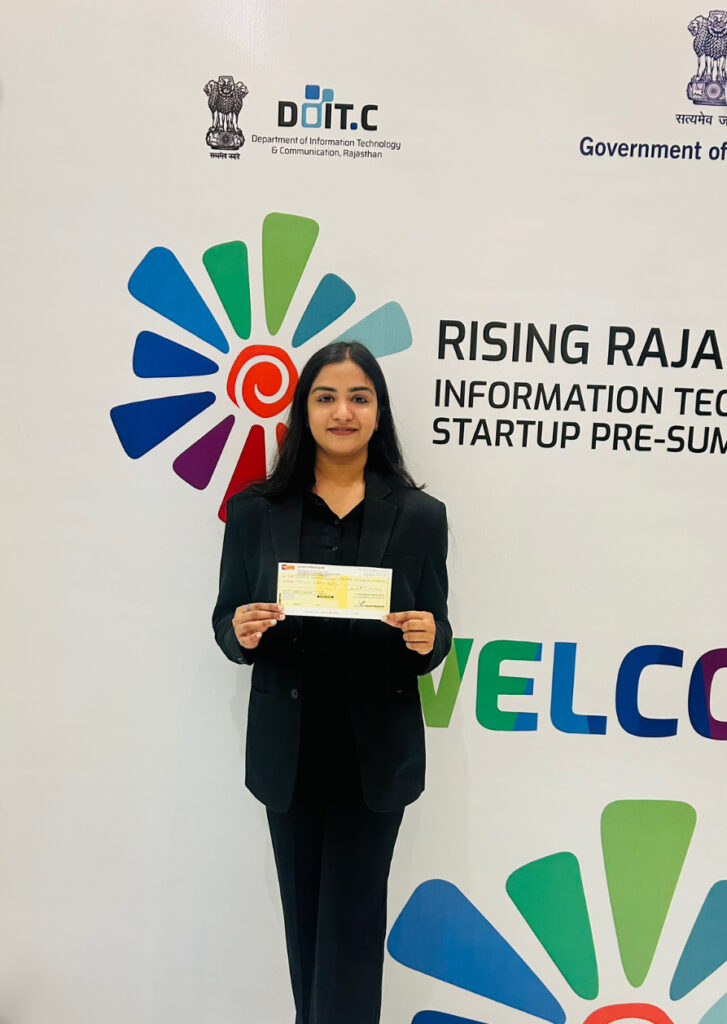
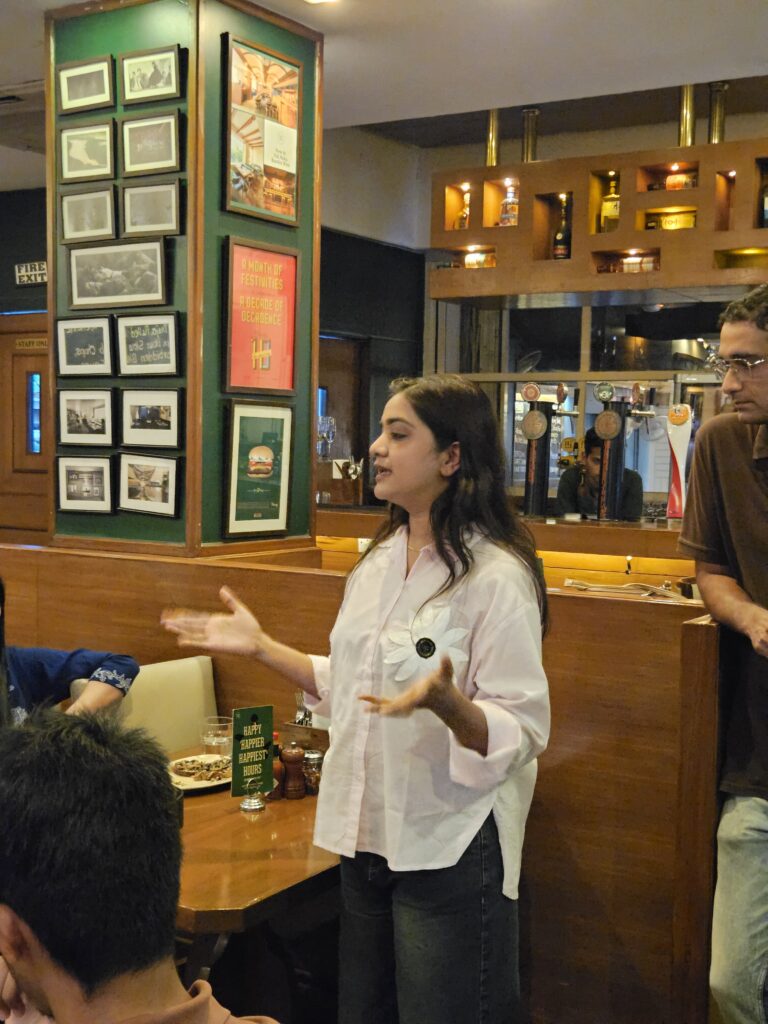
It was in this phase that Rhett, her legal-tech, AI-driven law firm and chamber, began to take shape. The name was intentional. Something timeless that would outlast the uncertainty of its early days. Rhett didn’t start as a structured company; it began as a group of college friends coming together and ideating during COVID.
The operating style was frugal. One friend built the prototype, others pooled in pocket money, and the prize money from the Punjab startup program became the initial fuel. Together, they began dreaming and building something that could address the gap in solving legal problems for customers who are often left in the dark due to a lack of information and complex legal processes.
It gave them a head start, but the money ran out faster than expected. Seeing the grit and commitment of Rupal and her co-founder, their fathers stepped in. Rupal’s father supported incorporation and registration expenses, while her co-founder’s father provided advisory guidance.
At its core, this was a bootstrapped beginning and a deeply uncertain one.
“Today, Rhett is transitioning from early to growth stage, with revenue reflecting encouraging early traction, expanding from B2B to B2G, and serving families and individuals.” And yet, despite this progress, Rupal openly admits that financial stability is still something they are working towards.
There have been ups and downs with teams, clients, and stakeholders, but through it all, one thing has remained constant; continuing to move forward, one step at a time. The doubts didn’t disappear. They never do. But she learned to build alongside them.
“There was a time I didn’t even know myself,” she says.“No clarity about what I was doing or why. Just the determination that I wanted to build with my co-founder.”
And while she was navigating her own internal uncertainty, the external world didn’t make it any easier. In her experience, gender bias wasn’t subtle. It was direct. People didn’t take her seriously. Even mentors who invited her to speak sometimes doubted her credibility. Her first client had to be off-boarded because he constantly questioned the platform, simply because it was led by a woman.
Investors weren’t very different. Trust was harder to earn, and terms weren’t always transparent. In one instance, she was given a take-it-or-leave-it deal, only to later realise she had been misled. But instead of turning bitter from these on-ground experiences, she drew out key life lessons.
She began to realise that the real battles weren’t always external. Many of them were deeply personal. Self-doubt, overthinking, and a constant fear of judgment will always exist. But what defines a founder is the ability to navigate through them. The insecurities were real and, at times, overwhelming but she learned that you don’t wait for them to disappear. You learn to work through them.
Whether it was criticism from unexpected places, including women clients who questioned and demoralised her efforts or internal challenges like managing teams and dealing with attrition, each experience pushed her to step into leadership, not as a designation but as a responsibility. Along the way, she learned to listen, to mediate, and to set clear boundaries.
And she continued.
What makes this journey even more powerful is how she sees leadership itself.
Rupal doesn’t believe she started as a leader. She believes she is becoming one. From someone who once felt undefined and unaware of her own value, she is now a founder consciously building herself every single day.
Her biggest challenge hasn’t been the market or competition. It has been alignment. Aligning with her co-founder, whose introversion contrasts with her extroversion. Aligning with teams, clients, expectations, and communication styles, and most importantly, aligning with herself.
“Anger affects everything,” she reflects. “My conflicts with family, with team members, the backlash. I had to change if I wanted their support.”
And as she evolved, so did her definition of success.
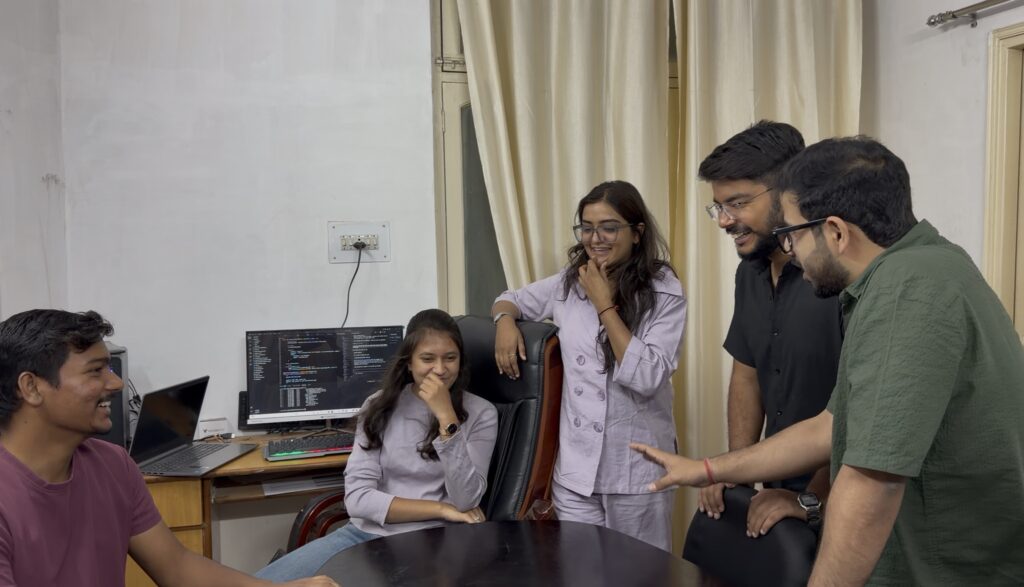
Today, it’s no longer just about revenue or scale. For Rupal, success means being heard for her vision, for her company, and for the people she is building it with. It means having access to the right platforms, the right partners, and the right resources.
And if you ask her what that one thing is she wishes she had known when she started, her answer is disarmingly simple:
“I wish I knew that to start my business, the only thing I needed was clarity and confidence… That’s it. Not perfect planning. Not external validation. Just clarity and the courage to stand by it.”
She believes entrepreneurship today is accessible, but only if you truly know what you want. You have to believe in your vision, be ready to pivot multiple times, and most importantly, learn to filter voices, because not every opinion deserves your attention.
At 25, leading a growing legal-tech company with a team of 9, Rupal Mathur is still in motion. Still building, still learning, still becoming.
Key Takeaways from Rupal’s Journey
- Sometimes, the safest path can quietly take you away from who you really want to become.
- Clarity doesn’t come before starting; it comes from starting.
- Self-conviction matters more than external validation, especially in the early days.
- Doubt doesn’t disappear; learning to build alongside it is part of the journey.
- Gender bias and external challenges exist but how you respond defines your path.
- The toughest battles are often internal: self-doubt, fear, and overthinking.
- Leadership is not a title; it is built through responsibility, empathy, and tough decisions.
- Alignment with people, expectations, and yourself is one of the hardest but most important aspects of building.
- You don’t need perfect plans to start. Just clarity and confidence.
- “Embarrassment is the cost of entry.” Showing up despite judgment is what sets builders apart.
“The truth is, you will be questioned, you will be doubted, and you will be misunderstood but none of that is the real barrier. The real challenge is choosing to continue despite it, to keep showing up even when the path feels uncertain and the noise around you grows louder.”
Rupal’s journey is not about having all the answers. It is about having the courage to move forward without them. It is about choosing conviction over comfort, growth over approval, and identity over expectation. Building a business is never just about what you create in the world. It is about who you become in the process. And that is the work that truly defines you!
If you feel inspired by Rupal’s story, connect with her on LinkedIn
Blog By: Nidhi Vadhera
Startup Strategist | Investor | Author (Romancing Targets)
Connect with Nidhi On LinkedIn